Welcome to Moniqo
New here? Start with this page to learn what Moniqo is, the philosophy behind it, and the key concepts you'll use every day.
Welcome
Welcome to the Moniqo User Guide. If you’ve never used budgeting software before, you’re in the right place. This page introduces what Moniqo is, why it works the way it does, and the small set of ideas you need to understand before you create your first budget.
You don’t need any prior budgeting experience to follow along. Moniqo is built to be learned as you use it, and this guide walks alongside you.
What is Moniqo?
Moniqo is an open-source personal budgeting application built around zero-based budgeting and the envelope budgeting method. It’s designed to be modern, clean, and easy to understand, whether you’re budgeting on your own, with your family, or sharing finances with someone else.
Moniqo tracks your finances using cash-based accounting, which means it reflects money as it actually moves; when it arrives in an account and when it leaves it, rather than projecting income or expenses that haven’t happened yet. This keeps your budget grounded in reality.
Moniqo is also privacy-first. Your financial data belongs to you, and the project is open-source, so anyone can see exactly how it works under the hood.
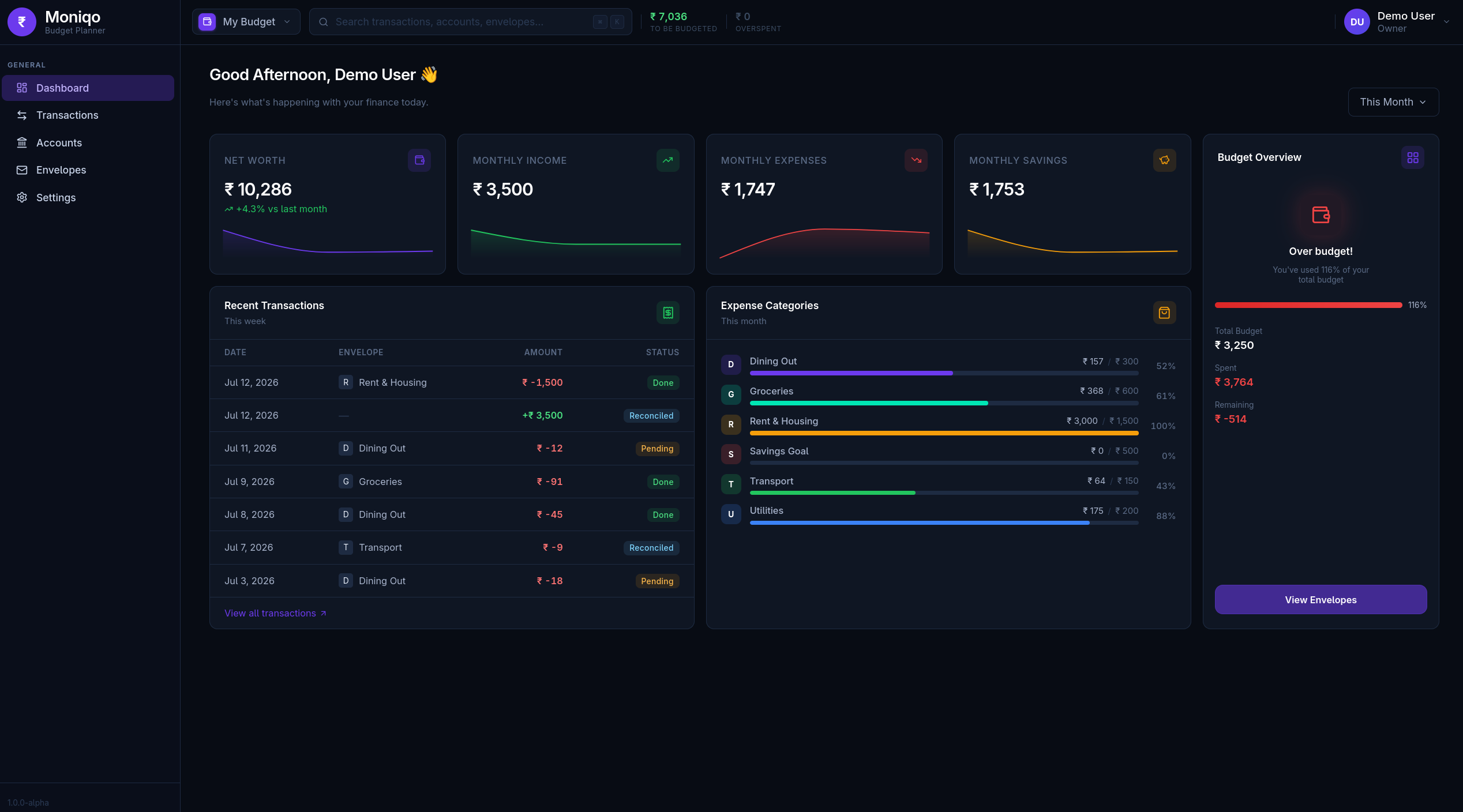
Why Moniqo?
Most people don’t struggle with budgeting because they lack discipline. They struggle because it’s hard to see, in the moment, whether they can actually afford something. Moniqo exists to close that gap.
The idea at the heart of Moniqo is simple: every unit of money should have a job. Instead of watching your bank balance and hoping it holds up until the end of the month, you decide in advance what each rupee is for. This turns budgeting from a guessing game into a clear, visual plan you can check before you spend.
This approach also removes a lot of the anxiety around money. When every rupee already has a purpose, you always know what’s actually available to spend, and what’s already spoken for.
Core Budgeting Philosophy
Moniqo is built on a small number of principles that shape everything else in the app:
- Every unit of money should have a job. Nothing sits around unassigned. If it’s in your budget, it has a purpose.
- Money lives in accounts. Your bank accounts, cash, and wallets are where money physically exists.
- Budgets organize money into envelopes. Envelopes represent categories of spending, like groceries or rent, and hold a planned amount of money.
- Transactions are the single source of financial truth. Every rupee earned or spent is recorded as a transaction. Nothing is inferred or estimated.
- Allocation is separate from spending. Deciding how much to set aside for something (allocation) is a different action from actually spending it. Keeping these separate is what makes zero-based budgeting work.
- Budgets are isolated financial workspaces. Each budget is its own self-contained space, with its own accounts, envelopes, and transactions.
Together, these principles give you a budgeting system that stays honest, because it’s built directly on what actually happened with your money.
Key Concepts
Before you start using Moniqo, it helps to know a few core terms. You’ll see these throughout the app and the rest of this guide.
- Budget: Your overall financial workspace. Everything else, accounts, envelopes, and transactions, lives inside a budget. You can have separate budgets for separate purposes, such as a personal budget and a shared household budget.
- Account: A place where your money actually sits, such as a bank account, a cash wallet, or a savings account. Accounts hold the real, physical total of your money.
- Envelope: A category you create to plan your spending, like “Groceries” or “Rent.” Envelopes hold a planned amount of money and help you see, at a glance, how much you have left for that purpose.
- Transaction: A record of money moving. Every time you spend, receive, or transfer money, you record it as a transaction. Transactions are what keep your budget accurate and truthful.
- Allocation: The act of assigning money from your available balance into an envelope. Allocating money is planning; it doesn’t mean the money has been spent.
- Spending: Using the money you’ve allocated. When you record a transaction against an envelope, it reduces that envelope’s balance, showing you exactly how much of your plan remains.
You don’t need to memorize any of this right now. These ideas will make more sense as soon as you start using Moniqo.
What You Can Do With Moniqo
Once you’re set up, Moniqo lets you:
- Create one or more budgets for different purposes, such as personal finances or a shared household budget.
- Add and track multiple accounts, including bank accounts, cash, and savings.
- Build envelopes that match how you actually think about your spending.
- Allocate your income across envelopes so every rupee has a plan.
- Record transactions as you spend, so your budget always reflects reality.
- Move money between envelopes when your plans change.
- Share a budget with family members or a partner, so everyone can see and manage the same financial picture together.
Who Moniqo Is For
Moniqo is built for anyone who wants a clear, honest picture of their money without unnecessary complexity. That includes:
- Individuals who want to plan and understand their own spending.
- Families and couples who want to manage shared finances together, with everyone working from the same budget.
- Anyone budgeting for the first time and looking for something approachable, rather than a tool built for accountants.
- People who value privacy and want to know exactly how their financial data is handled.
Whatever your situation, Moniqo adapts to how you already think about your money rather than asking you to think like a spreadsheet.
What You’ll Learn in This Guide
This User Guide will walk you through everything you need to budget confidently with Moniqo, including how to:
- Set up your first budget and understand how it’s structured.
- Add and manage your accounts.
- Create envelopes that reflect your real spending categories.
- Allocate money and record transactions as you go.
- Review reports and insights to understand your spending patterns over time.
- Share a budget with others and manage permissions.
Each topic builds on the concepts introduced here, so if you ever feel unsure about a term or an idea further into the guide, you can always come back to this page.
Next Steps
You now have a foundational understanding of what Moniqo is and how it thinks about money. The next step is to put that into practice.
Head over to the Getting Started guide, where you’ll learn how to:
- Create your first budget
- Add your accounts
- Create your envelopes
- Record your first transactions
- Begin budgeting with confidence
Take it one step at a time. You don’t need to get everything perfect on day one, you just need to start giving your money a job.